

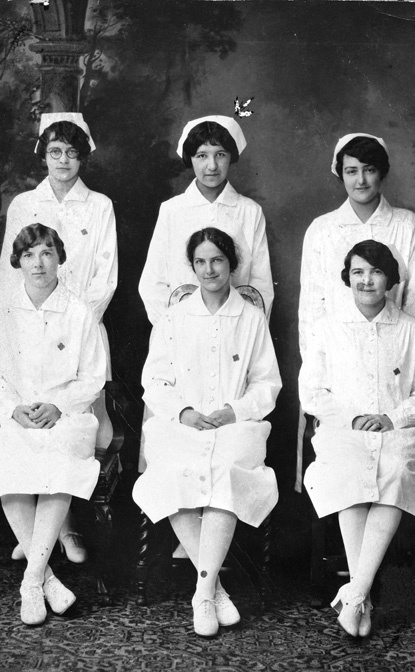
Yellowtail with her graduating class from the Boston City Hospital’s School of Nursing (back row, center), 1927 MHS PAc 87-70
Susie Walking Bear Yellowtail, a member of the Apsáalooke (Crow) Nation, was a pioneer in both healthcare and Native advocacy. She became one of the first Native registered nurses, dedicating her life to improving health care for Native peoples.
Yellowtail was born in 1903 on the Crow Reservation near Pryor, Montana. Orphaned at the age of 12, she was recruited by a missionary to attend a Baptist convention in Denver, Colorado. From there, her educational journey led her to Bacone Indian School in Oklahoma and eventually to Northfield Seminary in Massachusetts. In 1924, she enrolled in a nursing program at Franklin County Memorial Hospital and completed her training at Boston City Hospital in 1927.
With her new training, Yellowtail returned to the Crow Reservation as a nurse for the Indian Health Service. Despite the completion of a reservation hospital in 1916, many Crow people were wary of Western medical practices. Yellowtail witnessed firsthand the inadequate care and discrimination Native patients endured, including the widespread, non-consensual sterilization of Native women. According to Yellowtail, sterilizations were “routine practice” at the time, with many women unaware they could no longer have children until long after the procedure.
This trauma was part of a broader pattern of systemic abuse across many Indigenous communities, where Native women were subjected to involuntary sterilization. Medical professionals, influenced by racist and eugenicist ideologies, deemed Native women as “unfit” mothers and used coercion or deceit to gain consent—or bypassed it entirely. These actions had devastating effects on Native communities, undermining traditional family structures, eroding trust in medical institutions, and contributing to a long history of intergenerational trauma.
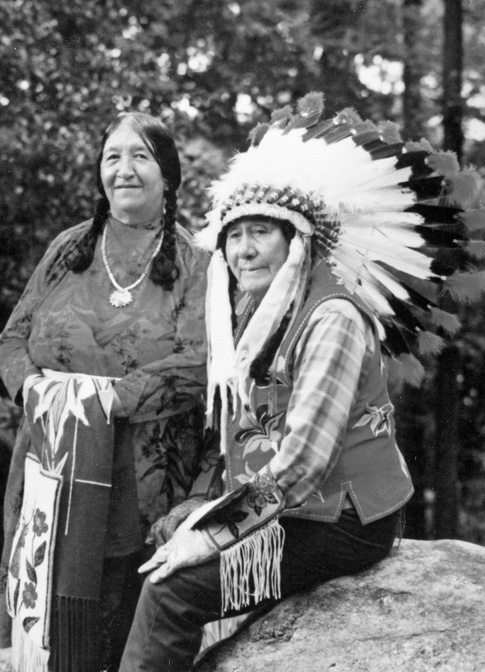
Yellowtail with her husband Thomas, undated MHS PAc 87-71
Yellowtail only briefly worked at the hospital on the Crow Reservation, resigning following her marriage to Thomas Yellowtail in 1929. In the 1930s, she became a midwife, combining her medical training with the traditional knowledge passed down from women in her tribe. By offering culturally sensitive, safe, and accessible childbirth services, she helped restore a sense of dignity and trust in healthcare among Native women. According to Yellowtail, by the mid-1930s, many women had entirely stopped giving birth in the reservation hospital, fearing the risks of forced medical procedures.
Throughout the 1940s and 1950s, Yellowtail’s efforts expanded to include advocacy on a tribal and national level. She served on the Crow Nation’s health and education committees and, in 1961, was appointed by President John F. Kennedy to the Surgeon General’s Advisory Committee on Indian Health. In this role, she traveled to reservations across the country, investigating health conditions and recommending reforms. As she had from the start of her career, Yellowtail advocated for improved care, increased access, and better conditions for Native people. For her work, she received the President’s Award for Outstanding Nursing in 1962.
Yellowtail passed away in 1981, but her contributions to health equity were recognized with her induction into the Montana Hall of Fame in 1987 and the American Nurses Hall of Fame in 2002.
Today, there is greater awareness of the need for comprehensive, affordable, and accessible reproductive care for all. The legacy of forced sterilization underscores the critical importance of the continued fight for reproductive justice. Across the country, organizations like FamPlan now strive to provide culturally competent, patient centered reproductive care for all—work that was hard won through the advocacy of leaders like Yellowtail.
Sources:
https://montanawomenshistory.org/susie-walking-bear-yellowtail-our-bright-morning-star/